The European Movement in Serbia organized a workshop with members of civil society organizations, environmental activists and interested citizens from Belgrade on the topic of “Monitoring Public Policies in the Field of Battling Climate Change”. The workshop was held within the project “Green Agenda at the Local Level”, which is implemented by members of the Network of the European Movement in Serbia in six local areas: Belgrade, Leskovac, Valjevo, Kraljevo, Sremska Mitrovica and Krusevac.
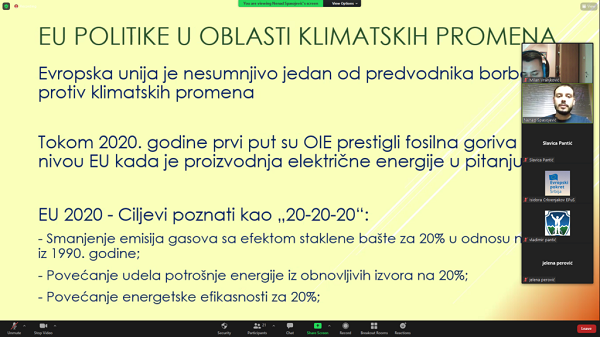
In the introductory part of the workshop, Nenad Spasojevic, an ecology expert from the Center for Policy Making and Strategies, presented the basic EU policies in the field of climate change.
The participants also discussed Serbia’s commitments in the field of climate change stemming from EU integration. The participants pointed out the problems of the lack of an adequate Climate Change Strategy and Low Carbon Development Strategy, as well as the delay in the adoption of the Integrated National Plan for Energy and Climate – INEKP. It was concluded that the slow energy transition, coal-fired power plants, industrial plants and individual furnaces contribute the most to defining the entire Western Balkans region as a leader in the level of air pollution in Europe.
In the continuation of the workshop, ways of monitoring the progress in the implementation of national and local policies in the field of climate change were presented. Citizens who want to participate in the fight against climate change are mostly faced with the problem of insufficient information on relevant legal regulations, as well as ways to obtain the support of fellow citizens and adequate information from the competent authorities. On this occasion, the participants of the workshop were introduced to methods for involving citizens in the fight against climate change, primarily through public debates, forums, round tables, sending requests, proposals, comments and organizing public performances.
Finally, representatives of the informal group “Battle for Kosutnjak” and the environmental organization “Econaut” shared examples of good practice, as well as their ideas regarding improving the capacity of citizens to monitor local and national policies in the field of climate change. Workshop participants concluded that educating citizens about legal regulations and networking with civil society organizations, informal groups and activists is the most effective way to make progress in environmental protection due to insufficient involvement of government representatives.